In 2011, Justin Bieber released “Mistletoe”, a Christmas song about kissing a girl underneath the famous holiday plant. Tween girls (this author included) swoon, and retail workers recoil at the incessant playing of the song, which unfortunately becomes less cute when you find out the mistletoe is a parasite. Yes: When Justin Bieber crooned that he “should be playing in the winter snow; but I’ma be under the mistletoe,” he sang about desiring to spend time with his girlfriend under a plant that kills other plants.
What is Mistletoe?
Mistletoe isn’t one plant; it is an incredibly diverse group of over 1,400 species affecting different plants in drastically different regions of the world. They are found in four different plant species within the order Santalales and can be seen from tropical South America to the Sierra Nevada mountains. In the Galena region and around Lake Tahoe, one of the most common species is dwarf mistletoe (Arceuthobium). It affects coniferous plants such as Jeffrey Pine, Ponderosa Pine, and White Firs (better known as Christmas trees).
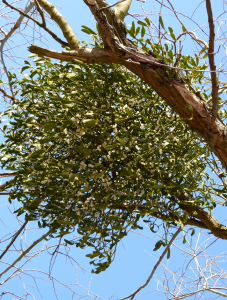
Dwarf mistletoe begins as seeds inside berries. In the spring, these berries burst, spreading the seeds to surrounding trees. The seeds are coated in sap, which allows them to cement to the stems of healthy trees; when the seeds sprout they attach to their host tree. It takes one to two years for shoots of mistletoe to form, and another year for fruit to develop. Dwarf mistletoe derives its nutrients from the tree, taking its nutrients, water, and health.
What happens to the tree?
Obviously, having nutrients and health taken is not good for the tree. After infestation occurs, the mistletoe forms manifesting itself in the image of “witches brooms”, large clumps of misformed branches that are caused by the parasitic infection. The infection affects trees from the top down, and the needles turn yellow and fall off as the tree begins to die.
The host tree is weakened by the mistletoe infestation, and eventually dies. Younger or weaker trees can die quickly after an infection, while older trees can survive over a decade with dwarf mistletoe. After the trees die, they continue to cause massive harm in forests. The seeds spread tree to tree, proliferating the parasite in the forests. Dead trees are uber flammable, and can worsen wildfires. Mistletoe can be treated by pruning, chemical treatments, or tree removal.
To Justin Bieber: Instead of bringing mistletoe to kiss your boo, maybe bring some pruning shears (or just buy fake mistletoe).